


Project Visegrad Grant No. 22620137
Lead Project Coordinator: Prof. dr hab. Grzegorz Graff,
Gdańsk University of Technology, Faculty of Applied Physics and Mathematics,
e-mail: grzegorz.graff@pg.edu.pl
Description of the project:
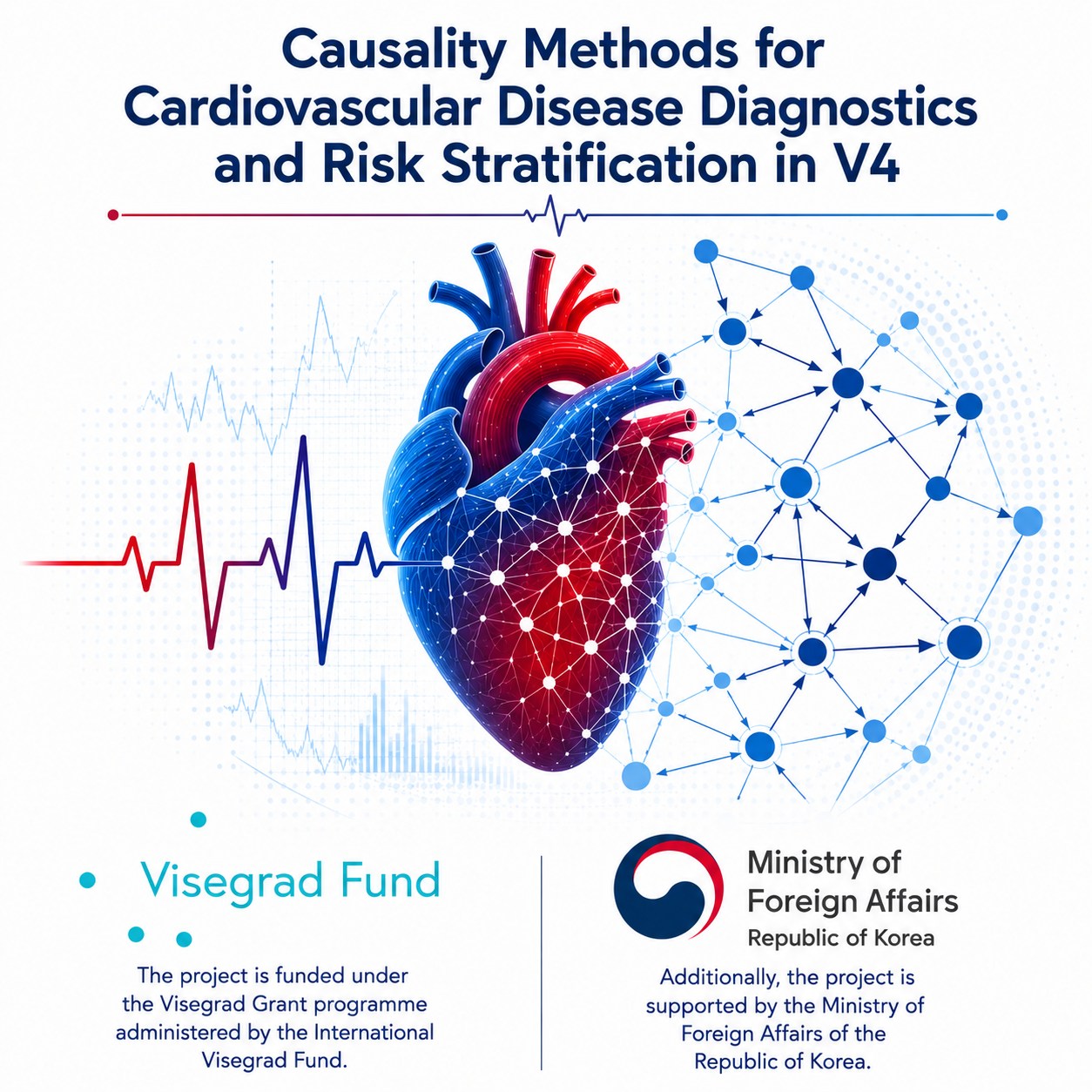
„Causality Methods for Cardiovascular Disease Diagnostics and Risk Stratification in V4” is a research project led by Gdańsk University of Technology and focused on developing advanced mathematical and artificial intelligence-based methods for identifying causal relationships within the cardio-respiratory system using multivariate time-series data.
By detecting directional interactions and early changes in physiological dynamics, the project aims to develop methods that can support earlier diagnosis, risk stratification, and prognosis of cardiovascular diseases. The research brings together applied mathematics, artificial intelligence, and biomedical engineering, contributing to the development of innovative approaches to biomedical data analysis.
The project will strengthen research and teaching expertise in causal modelling and multivariate physiological signal analysis, while creating a foundation for further scientific publications, applied research projects, and the development of prognostic tools.
An important aspect of the project is international cooperation within the Visegrad Group. Gdańsk University of Technology leads a consortium comprising research institutions from Poland, Slovakia, and Hungary:
- Gdańsk University of Technology – Project Leader, Poland. Team Leaders: Prof. dr hab. Grzegorz Graff, dr hab. Paweł Pilarczyk, prof. PG
- Medical University of Gdańsk – Poland. Team Leaders: dr n. med. Beata Graff, prof. dr hab. Krzysztof Narkiewicz
- Jessenius Faculty of Medicine in Martin, Comenius University – Slovakia. Team Leader: Prof. dr n. med. Michal Javorka
- Department of Computational Sciences, Wigner Research Centre for Physics – Hungary. Team Leaders: Dr Zoltán Somogyvári, Dr Marcell Stippinger
The partnership will facilitate joint research activities, the exchange of data and expertise, researcher mobility, and joint training activities. Through these activities, the project will contribute to building lasting regional partnerships and enhancing the international visibility of the participating institutions in the field of innovative, data-driven approaches to healthcare.
Details of the partners:
- Medical University of Gdańsk: one of Poland’s leading medical universities and a major centre of medical education, research, and healthcare in the Pomeranian region. The University conducts interdisciplinary research with a strong focus on medicine, biotechnology, and pharmaceutical sciences, and has particular research strengths in cardiology and cardiovascular medicine. MUG combines advanced research infrastructure with extensive clinical expertise and close cooperation with international research institutions and the socio-economic environment. Its strong scientific and clinical background makes MUG an important partner in the development and validation of innovative data-driven methods for cardiovascular disease diagnostics and risk assessment.
- Jessenius Faculty of Medicine in Martin, Comenius University: a prominent medical education and research institution in Slovakia. The Faculty provides education in medicine, dentistry, nursing, midwifery, and public health, as well as postgraduate and continuing education for medical professionals. Its activities combine education, scientific research, and clinical practice, supported by theoretical, pre-clinical, and clinical workplaces, with most clinical teaching activities based at Martin University Hospital. The Faculty is also actively involved in research and development projects and the modernization of research and educational infrastructure, providing a strong academic and clinical environment for interdisciplinary biomedical research.
- Department of Computational Sciences, Wigner Research Centre for Physics: an interdisciplinary research team specializing in computational science and advanced research computing. Its expertise covers areas including mathematics, computational and cognitive neuroscience, time-series and signal analysis, machine learning, artificial intelligence, Bayesian statistics, complex systems, and causality analysis. The Department also supports research communities through expertise in advanced research computing, high-performance computing, data analysis, and modern computational methodologies. This combination of mathematical, computational, and data-driven expertise provides a strong foundation for the development of advanced causal modelling and artificial intelligence methods for complex biomedical data.
The project is funded under the Visegrad Grant programme, administered by the International Visegrad Fund, and is additionally supported by the Ministry of Foreign Affairs of the Republic of Korea.